


Gorillaz, as a concept, has never been short of anything but ‘outside of the box,’ and this latest of their nine albums is perhaps their most ambitious yet. It takes the listener into a realm previously untouched by Damon Albarn, who founded the ‘virtual band’ in 1998 to explore musical avenues outside of the Britpop scene that Blur left him in.
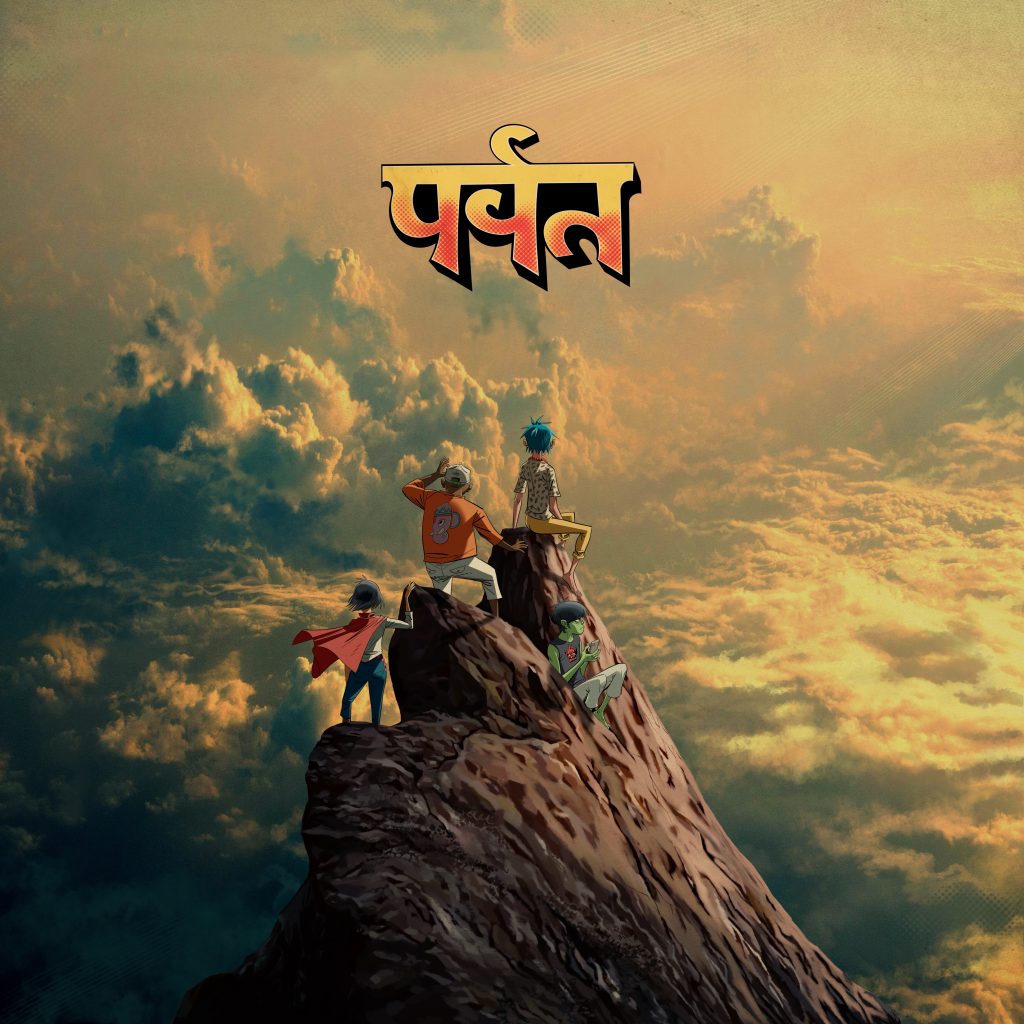
In an album that looks at grief in one perspective or another through the majority of its 15 tracks, The Mountain is a poignant insight into the struggles of identity and coping with loss after the passing of both musician Damon Albarn and artist Jamie Hewlett’s fathers in 2024.
It’s essentially a collaboration album, with each track featuring a multitude of artists, drawing inspiration from Indian Bollywood-style music and traditional Middle-Eastern influences, whilst also blending synthetic hip-hop and rap elements that the less avid listener will recognise from hits such as Clint Eastwood and Feel Good Inc.
The question of ‘What could Gorillaz possibly do next?’ is finally answered. The contrast between the almost abnormally ambitious sound and harrowingly reflective, human message in this collection restores much of the heart and character to the band that has felt somewhat lacking in previous records.
The album opens with its title track, which is a mostly instrumental, near-five-minute Indian-inspired introduction, making it clear from the outset that this is an introspective sort of album. For a band that’s so long producing music reflective of the world around them, sitting in this opening number and really focusing on the enchanting sounds of the Hindu sitar and bansuri flute is a pleasantly welcomed shift to inward expression. The end of the song, ‘The Mountain (All good souls come to rest),’ feels like a sort of embrace from the musicians, a microcosm of the album’s entire message: to live with a feeling of loss is the most integral part of the process.
We’re then segued into a contrastingly upbeat, funky tune, ‘The Moon Cave’, which recovers much of the traditional quirky blends Gorillaz fans will be accustomed to. Albarn’s vocals sit nicely on a grooving bassline, the lyrics a devastating juxtaposition to the synthetic rhythm– ‘Let me know/So I can say goodbye/And let it go’. It’s not long before The Roots rapper Black Thought brings the lyrical elements synonymous with a groovy Gorillaz classic, the interjections of the late Dave Jolicoeur’s ‘float’ and ‘topic’ flawlessly produced, ‘Where the masjid, where the church is?’ a nod to the Middle-Eastern influences later in the album.
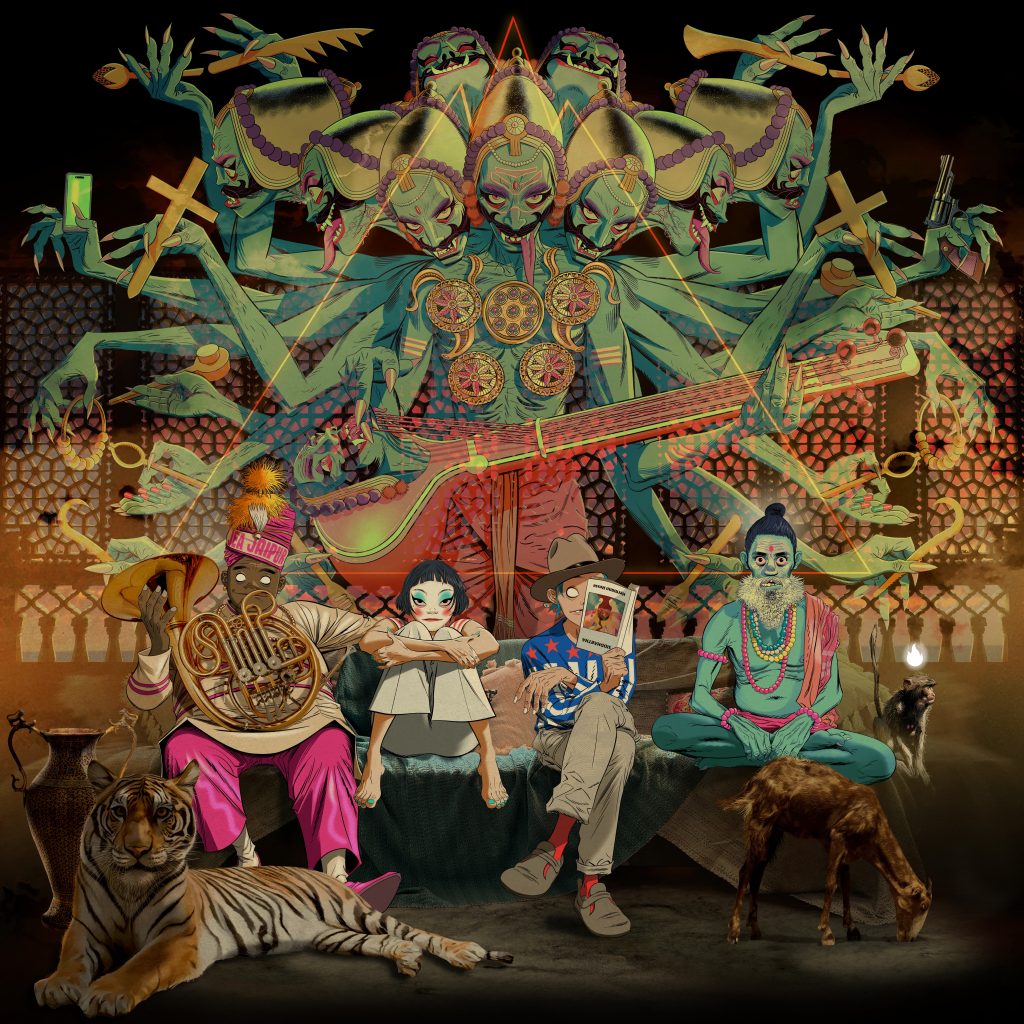
70s pop duo Sparks make a feature in the next track, ‘The Happy Dictator’, which leans heavily into their melodics to point a satirical finger at the blissful ignorance of those who avoid confronting real emotions. Albarn’s token melancholic vocals represent the avoidant- ‘Upon this world of fiction, my love I will bestow’, whilst the dreamy repetitions of Sparks’ ‘Oh what a happy land we live in’ highlight the reality that this front of happiness is a fallacy. Motifs of ‘Mountains and rainbows, palaces of love’ really drill this idea home, the notion of ‘No more bad news’ seemingly a reflection on Albarn’s part that he couldn’t run from grief forever.
Similar themes are brought forward later in the album, track nine’s ‘The Plastic Guru’ repeating ‘We believe what we choose/Is that not the truth’.
Track four, ‘The Hardest Thing’ opens with the repetitions of the late legendary afrobeat drummer Tony Allen, speaking Yoruba phrases that translate as ‘We are ready (let’s go)’. Albarn, as throughout the rest of the album, is touchingly raw with spoken word here. “You know the hardest thing is to say goodbye to someone you love… /And when the curtains rise, and the party begins/ Do you laugh? Do you break down inside?“
The first of these lines then opens the next track, ‘Orange County’, with the vocals of Kara Jacksoncreating a back-and-forth in the song, a bashful confession of vulnerability on Albarn’s part on a whimsical, whistling track- ‘I don’t know if I can take this anymore/So why are you trying to break me?’. It feels like a journey, an internal fight about legacy and growing old, which is in turn a revelation in itself as Albarn takes on Jackson’s lines towards the end of the song- ‘I’m not your enemy’ becomes a personal mantra rather than a conversation.
I struggled to place the next track, ‘The God of Lying’, with the rest of the album. The vocals of Joe Talbot of post-punk band IDLES are well-suited alongside Albarn in a sound incredibly reminiscent of Gorillaz’s first album, but not all encompassing of the vibe of The Mountain. Themes of a struggle with religion (There’s a terrific chance there’s nothing/Beyond what you believe) and political undertones (Are you happy with your housing… Are you deafened by the headlines?) feel a far cry from the introspective nature of the rest of the tracks. I enjoyed the song in isolation, but felt it detracted from the wider message.

Around the midway point of the album, we get the first feature of Johnny Marr, the former The Smiths guitarist, offering his hand in a spacey track, ‘The Empty Dream Machine’. It flutters between layers of this electronic flow and Anoushka Shankar’s sitar sound that initially opens the track. Albarn’s vocals again contrast the blissful melodic sound surrounding him with dejected lyricism– ‘Empty dream machine without you/Man’s in chains/His mind is at war again I fear’ expressing a real mental turmoil, a mirror held to the grief he’s experienced since the last Gorillaz album three years prior. In true Gorillaz fashion, the song takes a handbrake-turn halfway through, Black Thought returning with more rap that carries the song back to Damon, who echoes what feels like a conversation with ghosts– ‘I need you on my team’. More and more as this album progresses, it feels as if Albarn is learning to accept death as part of life’s cycle, mimicking Hindu beliefs of samsara that the eternal soul lives on.
This is perhaps the reason for the uplifting start to the next number, ‘The Manifesto’, which begins with Argentine rapper Trueno bringing Latin influences with upbeat bongo drumming and Spanish lyrics describing looking ahead to the afterlife– in his words, ‘Chapter two of this tale.’ This look ahead to life after death is literally manifested in the song; after a spirited interjection by Albarn, it transitions into a brutal freestyle by Detroit rapper Proof, who died in 2006. There’s a touching nod to these now-gone musicians throughout the album that contributes to the aforementioned samsara motif really powerfully.
Another of these musicians remembered in The Mountain is Mark E. Smith of The Fall, whose iconic post-punk voice makes up the titular chorus in track 10, ‘Delirium’. It adds yet another switch-up in genres with a heavy disco lean, stylistically bold and slightly jarring in the way it contrasts Albarn’s monotony and the obscure rhythm-induced callouts of Smith– ‘Peg-legged slave trader/You shrunken China chief head dealer’.
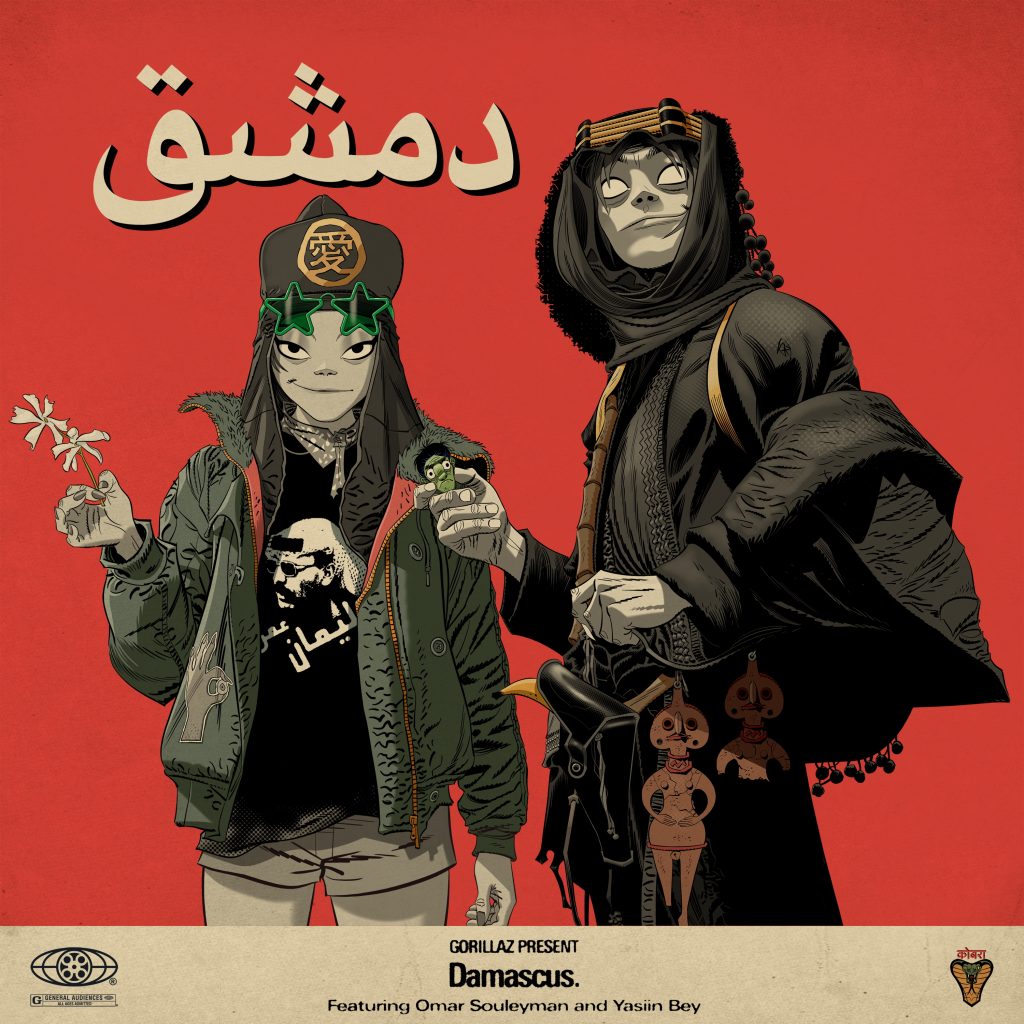
There’s barely enough time to recover from this thematic shift to prepare for ‘Damascus’, one of the album’s six singles that I remember hearing first months ago in the car with some friends who speak Arabic. One, from Yemen, had been playing me traditional Middle-Eastern music and was explaining the lyrics when this song, new at the time, came up in the conversation. Knowing Yassin Bey from his work under the name Mos Def, I instantly loved the track. It became a real bridge in culture for me and these friends who loved the melodics and lyricism of Omar Souleyman, explaining the romantic meanings behind Souleyman’s words and likening the rhythm and sounds to those they’d grown up with. It’s not the most technically astounding or emotively invoking track on the album by any means, but certainly a song that means a lot to me and is more digestible to a mainstream audience than the experimentation on much of this collection.
‘The Shadowy Light’follows, with the iconic Asha Bhosle from India delivering a beautiful performance at 92 years old– ‘Come, O boatman, lower my boat into the deep end/And take me to the other side’. Bhosle described in an interview that the lyrics of this song, which she interpreted as the boatman being a metaphor for music, carrying her down the river of life, convinced her to lend her voice to the track. It’s a poignant approach to mortality from a perspective of closeness to death, approaching the ‘shadowy light’, with Welsh composer Gruff Rhys featuring in the final verse, echoing ‘Living is the ending/The end of the beginning’, which continues the theme of the entire album unabashedly.
‘Casablanca’, at first glance, shapes up to be one of the most musically defined tracks of the collection, with Johnny Marr returning on guitar and The Clash’s Paul Simonon picking up the bass, sounding exactly as you might expect in a collaboration between Gorillaz, The Smiths and The Clash. It has the sort of dismal yearning of the last person left on Earth facing existential questions of reality, a doorway into the head of Albarn- ‘Motorway Casablanca/Where the tunnel to suburbia/Is opening soon.’ His gloomy calls of ‘I don’t know anything/That feels like this’ run on repeat over a sonically quite calming track that feels like a tender sort of closure.
The next song, ‘The Sweet Prince’, has a similar feeling– a dreamy wonder through an inner dialogue, words of reassurance and acceptance. ‘There are scars that will never heal/So why pretend they’ve gone away.’ There’s a rare instance of genuine personal storytelling on Albarn’s part here. Stripped away from the cryptic metaphors of much of Gorillaz’s past work, there’s a powerful glimpse into fleeting moments with his father before his death. ‘Found myself by your bedside/Looking out across the void/I was trying to say I love you/But you just turned and looked away’. For every ounce of internal conflict throughout this album, regret and self-loathing and grief, this penultimate track offers a real sense of resolution and long-awaited comfort that offers itself not just to the listener, but the narrator too.
Concluding the album is ‘The Sad God’, with Ajay Prasanna and Anoushka Shankar returning from the first track to lend their instrumentals in a song that feels simultaneously hopeful and a little sad. Albarn’s wistful chorus is echoed by child-like choir singing, particularly affecting lyrics like ‘I gave you blue skies/Sweet fallacy’ and ‘I gave you garlands/You closed your eyes/In paradise’, standing out. With the track slowly bleeding away, the final inputs from the Indian instruments that added so much flavour throughout the album truly pull together a stylistic success. For an album that is so versatile in genre and sound, with five different languages worked into the mix, it weaves elements together so naturally that it doesn’t feel disjointed at all.
When Albarn’s father died, he travelled to the Ganges River in India to scatter his ashes. By dualling tributes to the music of that region with an insight into the musician’s internal grapple with grief throughout the album, there’s a real sense of unique creative cohesion that emerges.
For a band whose sound, vocally at least, is so synonymous with melancholy and gloom, Gorillaz convey death in a responsibly dignified and comforting manner here, whilst still making the absolute most of their far-reaching creative licence.


